
Asphalt vs. Concrete: Not a Black and White Choice
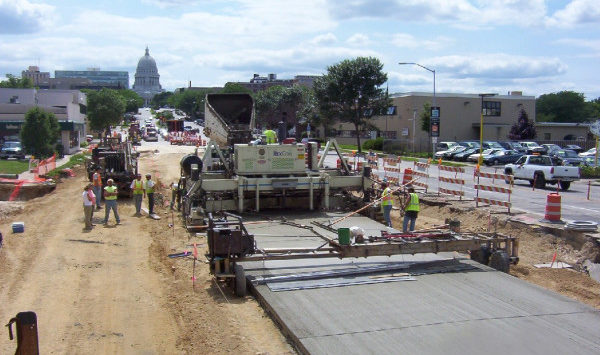 The most basic way state and local transportation departments can decide whether to pave a road with concrete or to go with asphalt is pretty simple: Asphalt costs less initially, but concrete lasts longer.
The overall trend of rising oil prices since 2000 has raised the price of asphalt and reduced its price advantage over concrete, but 93% of paved roads are still made of asphalt, according to the National Asphalt Pavement Association.
On the other hand, the Portland Cement Association boasts that about 60% of the interstate system is paved with concrete.
That disparity in pavement types between main highways and the rest of the United States’ roads points to one of many factors that can pull a public road agency in one direction or the other when deciding in favor of a ribbon of black vs. a ribbon of whitish-gray. Here are some of the key factors:
High traffic counts – particularly heavy truck volumes – make concrete a desirable choice because it simply holds up better under heavy loads. Hence the tendency for state departments of transportation to go with concrete on interstates.
Roadway segments with high turning movements and stopping points also present some disadvantages for asphalt since it is prone to tearing under these stresses. But even this is not a black-and-white matter. Harder oils can be used in asphalt mixes to reduce rutting, but this can also make the asphalt more brittle. Likewise, the wrong oil in an asphalt mixture can lead to cracking in extreme cold and rutting in extreme heat.
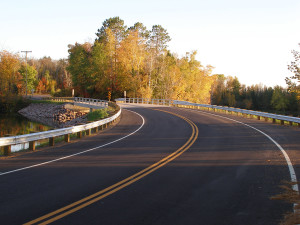 Asphalt provides a nicer, smoother, often quieter ride when relatively new. Concrete can be noisier because it is tined or broomed during construction to make it rough enough to provide good tire grip. And slight shifting and settling of the many slabs of concrete over time can produce that rhythmic ka-tunk, ka-tunk, ka-tunk sound motorists know well.
Harsh winter conditions present some disadvantages for concrete. The darker asphalt pavement warms up as sunlight hits a plowed roadway, and Mother Nature helps melt away any snow left behind by plows. Salt used for snow removal also can eat away at concrete, so some municipalities opt for a no-salt policy for the first winter or two after a concrete road is built. Read about how high friction pavement treatments increase tire grip around curves during bad weather.
Another geographic factor comes into play when the locally available aggregate that goes into a concrete mix has a high chert content. These chert pieces in the finished concrete collect moisture, and then during freeze-thaw cycles in the spring and fall the chert expands and pops out of the pavement, causing pock-marking.
Simpler repairs: For counties and small villages, asphalt is attractive because these agencies have the relatively simple equipment that can accomplish patching when maintenance is necessary.
Fewer repairs: Cities may opt for concrete because it provides for less frequent repairs and better strength under the crush of heavier traffic volumes.
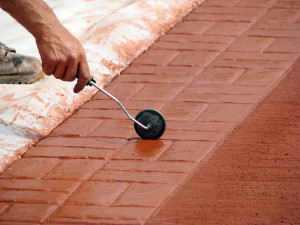 Stamping and coloring: In urban settings, concrete also offers clear advantages if stamping and coloring is desired as a way to increase safety at crosswalks or to generally enhance aesthetics.
Roll and go: Clients also consider the construction process, in which asphalt is ready to drive on as soon as it is compacted by a roller. Concrete typically must cure for seven days after pouring. High-early-strength concrete varieties offer a one- to three-day curing period where shortening construction inconveniences is critical.
Ultimately cost is a primary consideration, and DOTs look at the life cycle cost over 50 years when comparing the two pavement types and their relative costs initially and in terms of maintenance.
The concrete 50-year life cycle, while variable, might look something like this:
1. Joint repair or joint repair and diamond grind.
2. Joint repair and diamond grinding or joint repair and hot mix asphalt overlay.
3. Joint repair and hot mix asphalt overlay.
4. Reconstruction or pavement replacement including rubbilization.
The asphalt 50-year life cycle, also variable, might look like this:
1. Hot mix overlay or mill and hot mix overlay.
2. Second round of hot mix overlay or mill and hot mix overlay.
3. Third round of hot mix overlay or mill and hot mix overlay.
4. Reconstruction or pavement replacement including pulverization.
In 2002 the Colorado DOT placed both concrete and asphalt on Powers Boulevard in Colorado Springs to determine the pros and cons of each pavement while each is exposed to the same weather, soil, and traffic conditions. The northbound lanes were paved with concrete and the southbound with asphalt. The 15-year study should produce some conclusions next year.
In the meantime, we give our clients as much information as we can to help them make sound paving decisions. The Village of Lake Hallie, Wisconsin, just decided to go with asphalt after soliciting both concrete and asphalt bids for its 2-mile-long reconstruction of the heavily traveled Business USH 53. The low bid for asphalt was $4,697,551.44, and the lowest concrete bid was $5,473,218.58. The Village based its decision largely on the nearly $700,000 initial cost differential, along with the need to go with salt-free snow removal for one or two winters after construction if it had gone with the concrete option.
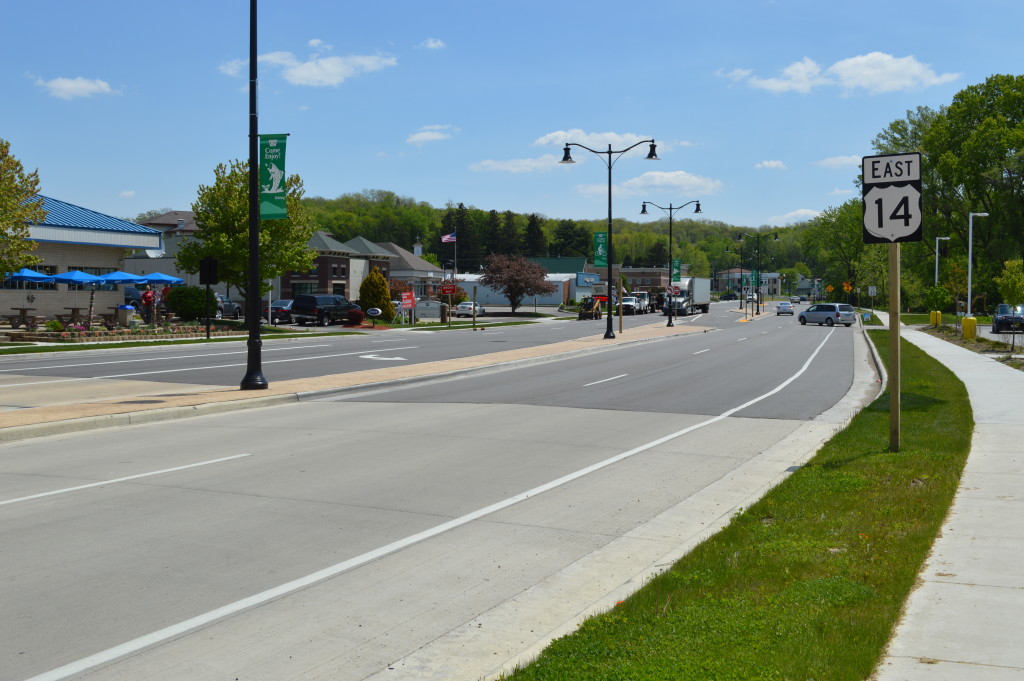
The Wisconsin Department of Transportation and the Village of Cross Plains opted for some concrete pavement and some asphalt pavement on the recent USH 14 reconstruction project stretching more than 1 mile through the Village, pictured here. The pavement choices were mostly aimed at achieving the most aesthetically pleasing look for the downtown area.
If you have questions about making the concrete vs. asphalt decision, contact one of our Transportation experts.


